
Planning to Relocate to Malaysia? 10 Things You May Have Missed (2026 Guide)
Most people moving to Malaysia already have the big things sorted before they land: the visa, the job, maybe even the condo. But after helping thousands of newcomers settle in through our community, we've noticed the same handful of things catch people out again and again, usually a few months in, when they're harder to fix.
This guide goes through the 10 we hear about most, with what the rules actually are, what to watch out for, and what we'd do in your shoes. Bookmark it, share it with your partner, and if anything doesn't make sense for your situation, message us. That's what we're here for.
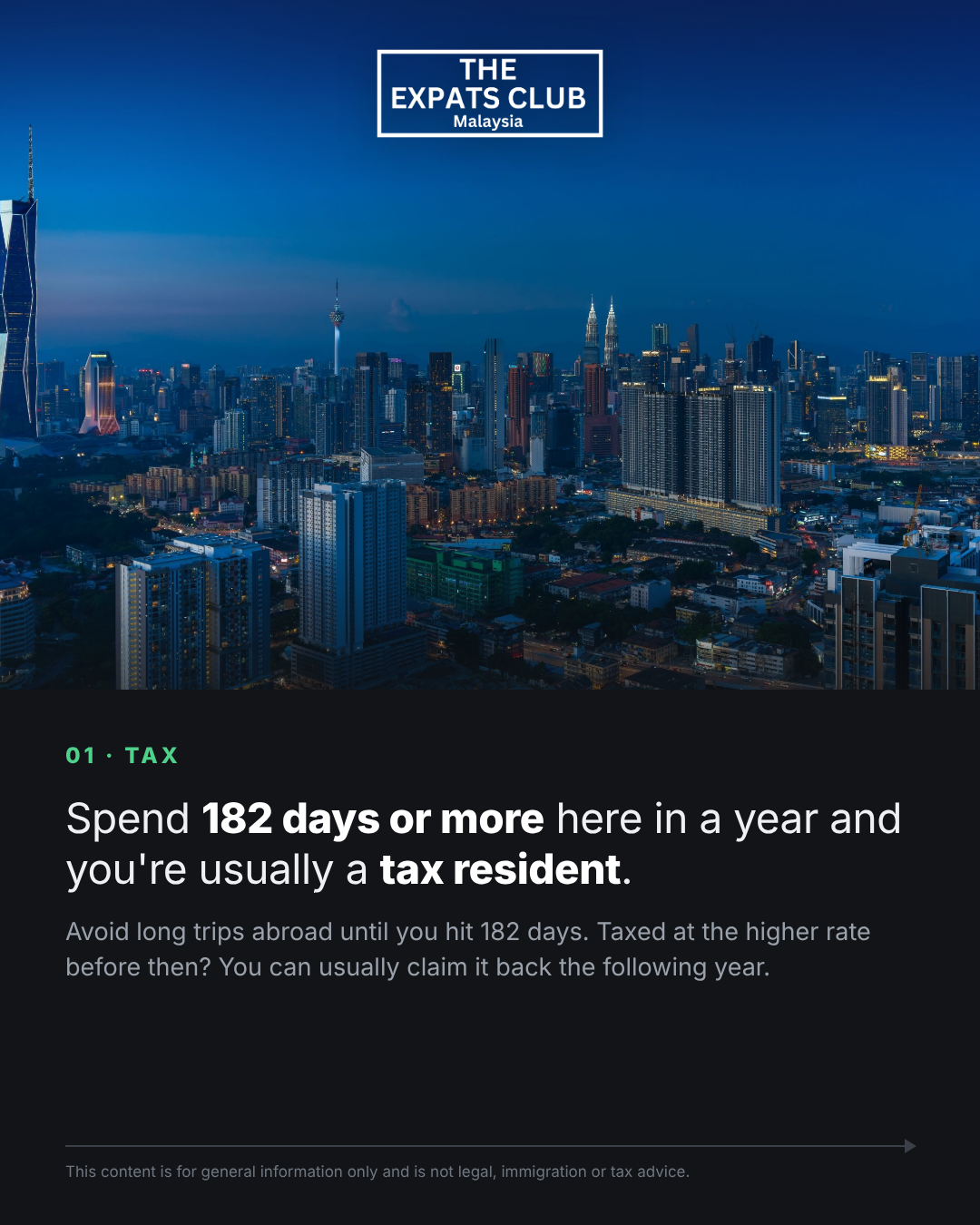
1. The 182-day tax rule (and why your first year matters)
In Malaysia, your tax status depends on how many days you spend in the country, not your nationality or your visa. The main rule is simple: if you're in Malaysia for 182 days or more in a calendar year, you're usually treated as a tax resident.
Why it matters
- Tax residents pay progressive rates on their Malaysian income and can claim personal reliefs. From the 2027 year of assessment, Budget 2027 raises the basic personal relief to RM12,000 and trims some middle-income rates.
- Non-residents pay a flat 30% on Malaysian income and can't claim personal reliefs.
- Tax-resident individuals also benefit from an exemption on most foreign-sourced income received in Malaysia, currently until 31 December 2036, subject to conditions.
The days don't need to be in a row
Your 182 days are counted across the whole calendar year. There are also "linking" rules: for example, if you arrive late in the year and spend fewer than 182 days here, you can still be treated as a resident if that period links to 182 consecutive days that run into the following year. Short absences, such as a social trip of up to 14 days, can sometimes still count towards a continuous stay.
Our tip for your first year
Try not to take long trips abroad until you've reached 182 days. In your first months, your employer may deduct monthly tax from your salary at the higher non-resident rate, because you haven't qualified yet. The good news: once you qualify as a resident, you can usually claim the difference back when you file your tax return the following year through LHDN's MyTax portal.
What to do: keep a simple record of your travel dates, register for an income tax number, and speak to a qualified tax adviser if you have income from more than one country.
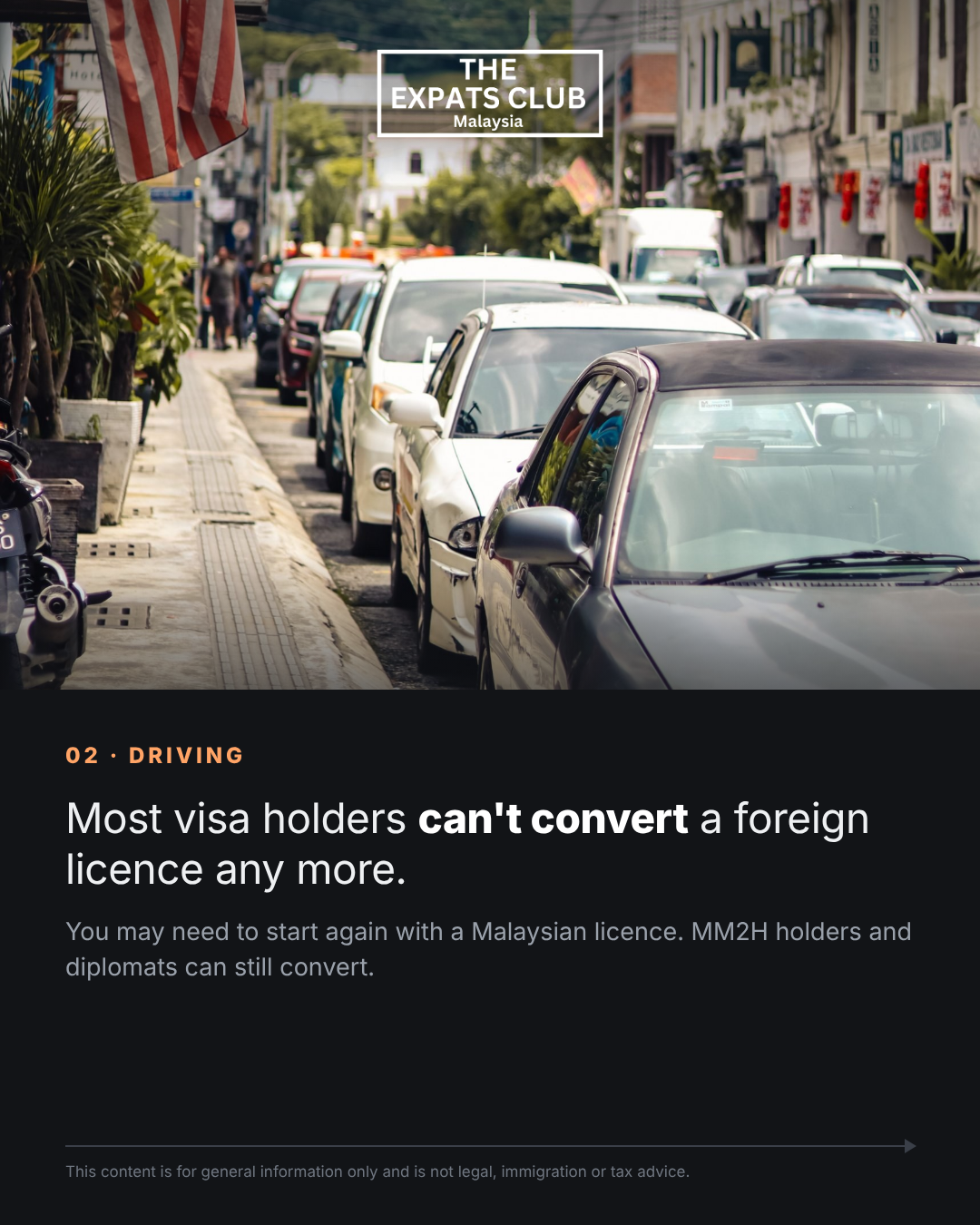
2. Most foreign driving licences can't be converted any more
This is one of the biggest surprises for new arrivals. Since 19 May 2025, the Road Transport Department (JPJ) has stopped converting most foreign driving licences into Malaysian ones.
Who can still convert
- Malaysia My Second Home (MM2H) participants
- The diplomatic corps
- Malaysians who only hold a foreign licence
Everyone else starts as a learner
If you want a Malaysian licence, you follow the same path as a local learner driver:
- Join a JPJ-approved driving school and complete the theory course.
- Pass the computer-based theory test (available in English).
- Pass the circuit test and the on-road driving test.
Staying less than 12 months?
You can usually drive on your home licence with an International Driving Permit, as long as your country signed the 1949 or 1968 road traffic conventions. ASEAN citizens can generally use their home licence.
What to do: budget time and money for driving school if you're staying long term, or look at alternatives such as car subscriptions. See our guide to the easiest way for expats to get a car in Malaysia.
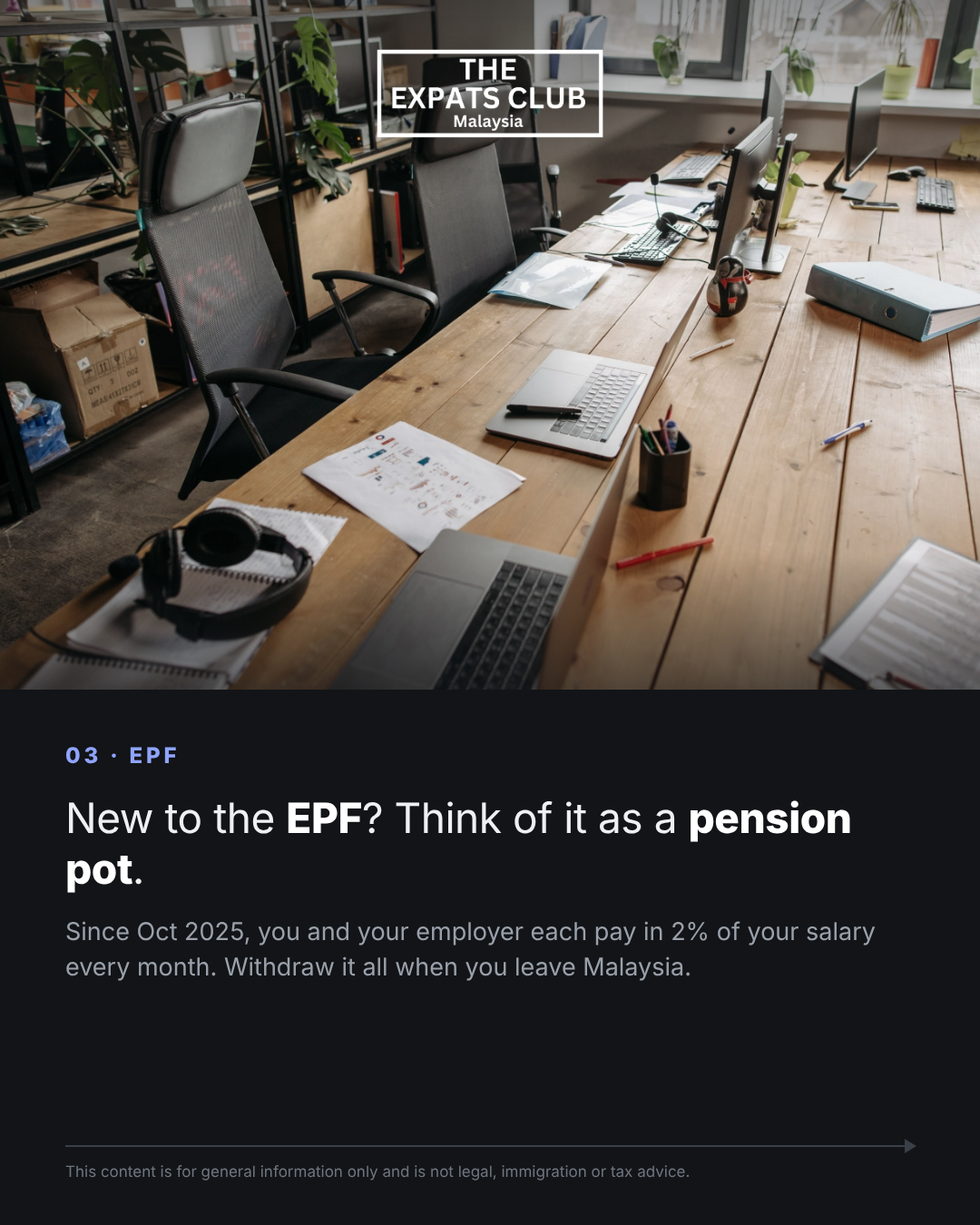
3. New to the EPF? Think of it as a pension pot
The Employees Provident Fund (EPF), or KWSP in Malay, is Malaysia's national retirement savings scheme. Until recently, most expats didn't need to think about it. That changed in October 2025.
How it works for foreign employees
- Non-Malaysian employees with a valid passport and work pass now contribute to the EPF.
- You pay 2% of your monthly salary, and your employer pays another 2%.
- Domestic workers are exempt.
Can I get it back?
Yes. Leaving Malaysia for good is one of the reasons you can make a full withdrawal of your EPF savings. Think of it as a small pension pot that builds up while you work here and comes with you when you go.
What to do: check your payslip shows EPF contributions, register for the KWSP app or online account so you can see your balance, and keep your details up to date before you leave.
4. Work health insurance often covers small visits, not big bills
Malaysia's private hospitals are excellent, but they're not free, and a hospital stay can add up quickly. Many employer health plans are generous for clinic and GP visits but have low limits for hospital stays and surgery.
Questions to ask about your work plan
- What's the yearly and lifetime limit for hospital treatment?
- What's the daily room and board limit? A private room can cost more than your plan covers.
- Are your spouse and children covered, and on the same terms?
- Are existing conditions or maternity covered?
- What happens if you change jobs or leave Malaysia? Group cover usually ends when your employment does.
Top up if you need to
You can take out a local or international health policy alongside your work plan, so you and your family are properly covered. If you're bringing dependants on an Employment Pass, health insurance is also part of the requirements.
Good news for 2027: Budget 2027 says private hospitals will start using standardised, clearer billing categories, making it easier to understand what you're paying for.
5. Save your preferred hospital's emergency number
Nobody likes to think about emergencies, but a few minutes of preparation now can make a huge difference.
In a life-threatening emergency, call 999
999 is Malaysia's emergency number. For medical emergencies, it connects you to the public ambulance service. Public hospital emergency departments treat everyone, although non-citizens pay higher rates.
Know your private hospital too
Most expats use private hospitals. Many of them run their own 24-hour emergency line, so it's worth saving the number of the hospital you'd prefer to go to, especially the one closest to your home.
What to do this week:
- Save 999 and your nearest private hospital's emergency number in your phone.
- Keep a photo of your passport, visa and insurance card on your phone.
- Save your insurer's 24-hour helpline. Private hospitals often ask for a deposit or a guarantee letter from your insurer before admission.
6. QR payments will save you so much time
From hawker stalls and night markets to hospitals and utility bills, Malaysia runs on QR payments. Once you're set up, you'll rarely need cash.
How it works
- Malaysia's national QR standard is DuitNow QR. Look for the DuitNow logo.
- Most Malaysian bank apps and popular e-wallets, such as Touch 'n Go eWallet, can scan and pay DuitNow QR codes.
- Some shops display a QR code for one specific e-wallet only, so it's handy to have your bank app and one e-wallet set up.
What to do: open a local bank account as early as you can, download your bank's app, and set up Touch 'n Go eWallet. A physical Touch 'n Go card is also useful for tolls, parking and public transport.
7. Your home-country will may not be enough
This one isn't fun to think about, but it's important. If you own assets in Malaysia, such as property, a car or a bank account, a will made in your home country may not be enough to deal with them smoothly.
Why it can be complicated
- A will that doesn't meet Malaysian requirements may not be recognised here.
- If your home country is in the Commonwealth, a grant of probate from home can usually be "resealed" by a Malaysian court. If not, your family may need to apply for a fresh grant in Malaysia, which can be slow and costly.
- Without a valid will, assets in Malaysia may be distributed under Malaysian law rather than your wishes. Different rules apply to Muslims.
What many expats do
Many expats make a separate Malaysian will that covers only their Malaysian assets, alongside their will at home. It's a relatively simple step that can save your family a lot of stress. Speak to a qualified lawyer about your situation.
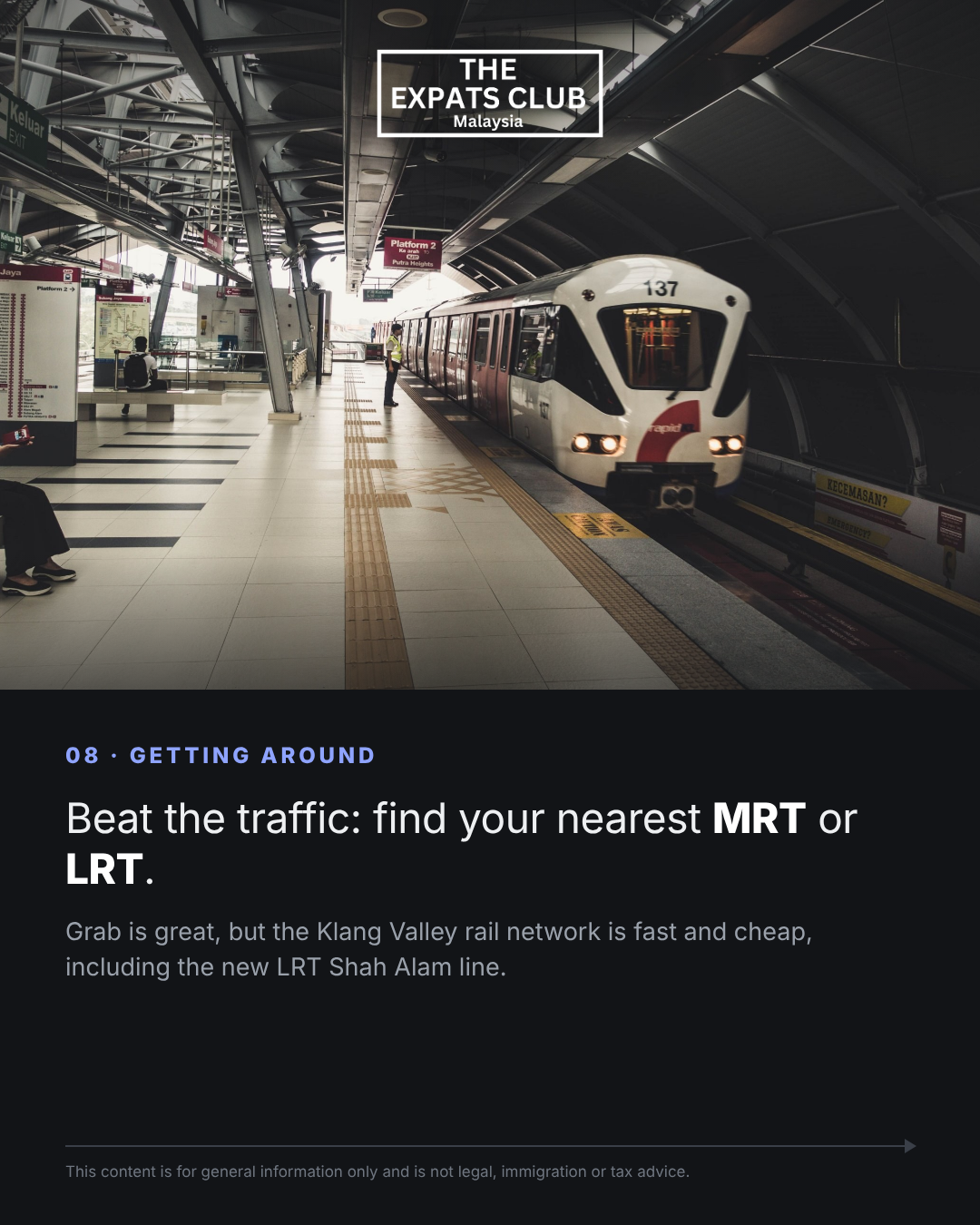
8. Beat the traffic with the MRT and LRT
Grab is brilliant, and you'll use it a lot. But at rush hour, Klang Valley traffic can turn a 15-minute trip into an hour. The rail network is often the faster, cheaper option.
Getting to know the network
- MRT lines run across the Klang Valley, including the Kajang and Putrajaya lines.
- LRT lines include Kelana Jaya, Ampang, Sri Petaling and the new LRT Shah Alam line, which opened in 2026.
- The KL Monorail, KTM Komuter trains and the KLIA Ekspres to the airport complete the network.
How to pay
Use a Touch 'n Go card at the gates. Credit and debit card "tap to pay" at the gates is being rolled out over the coming months and years.
Our tip: when you're choosing where to live, check how far you are from a station. Living within walking distance of an MRT or LRT stop can make a huge difference to your daily life.
9. Panas means hot. Pedas means spicy.
Malaysian food is one of the best things about living here, and a few words of Malay go a long way at the hawker stall.
- Panas: hot (temperature)
- Pedas: spicy
- Tak pedas: not spicy
- Kurang pedas: less spicy
- Ais: iced (as in teh ais, iced tea)
- Tapau: takeaway
- Terima kasih: thank you
Don't mix up the first two. One of us learned that the hard way! 🌶️

10. Join the community
Moving abroad can feel lonely at first, even in a city as lively as Kuala Lumpur. The quickest way to feel at home is to meet people who've done it before you.
The Expats Club Malaysia runs events every week across KL, Penang, Johor and Kuching:
- The Curry Club: our monthly flagship dinner
- She Knows a Spot: our women's group, with brunches, sip & paint and spa days
- Men's group: meet-ups and men's mental health support
- Sports: golf, pickleball, padel, squash, futsal and weekly hiking
- Retiree & MM2H Club: a monthly lunch and charity raffle
- Expat Business Forum: for business owners and founders
- Charity days: every event supports a local cause

Get your free Relocating to Malaysia guide
Want all of this in one place, plus visas, choosing where to live, finding the right home, international schools, culture, healthcare and a first-30-days checklist? We've put everything we've learned into our free Relocating to Malaysia guide.
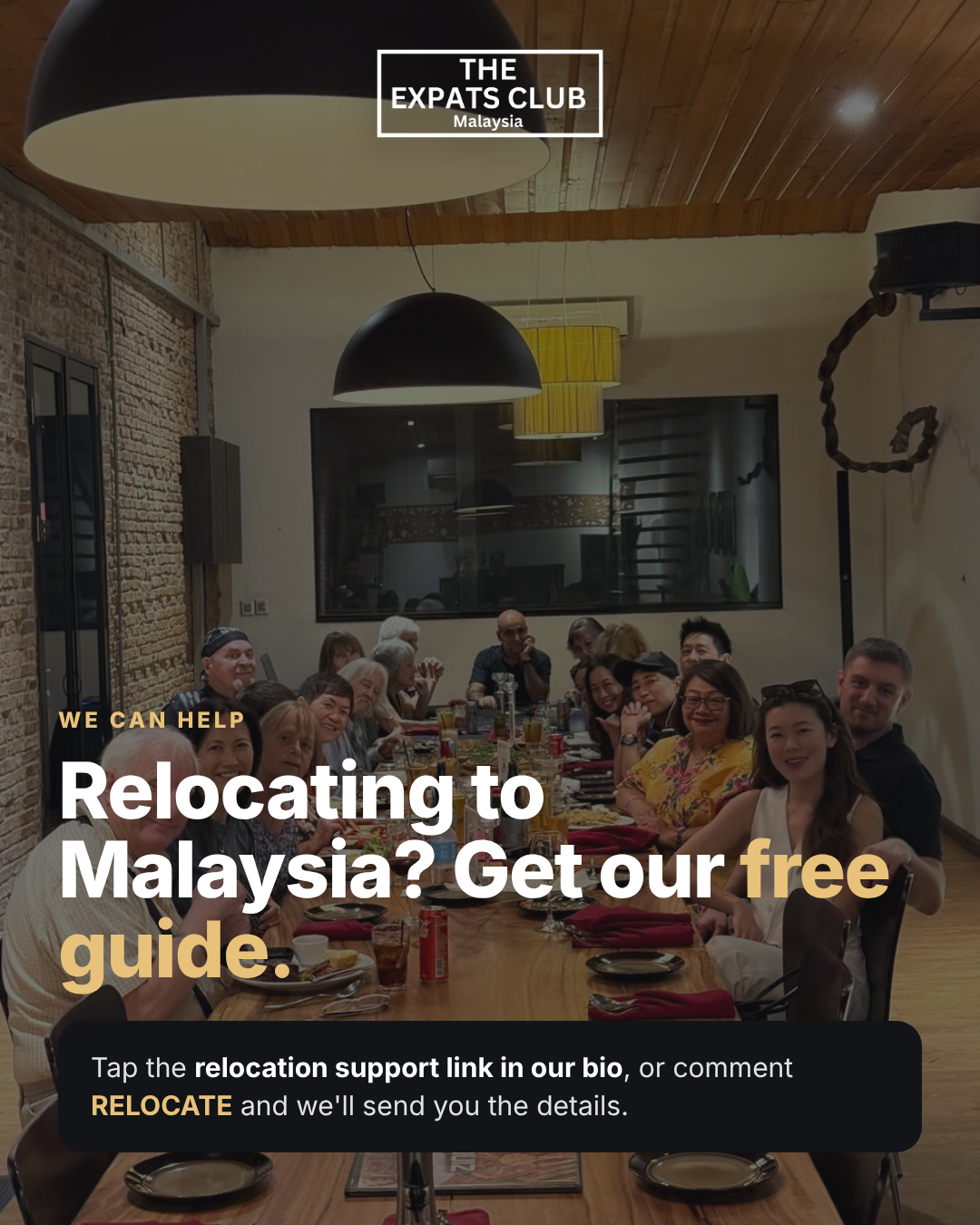
Here's how to get it:
Fill in our relocation support form and tell us a little about your move: Relocation support form
If you're relocating to Malaysia and want advice on anything, just reach out. We can help answer your questions and add you to our community.
WhatsApp: +60 14-845 9471 · Email: hello@expatsclubmalaysia.com
This article is for general information only and is not legal, immigration, tax, financial or medical advice. Rules change, so always check with the relevant authority or a qualified adviser. Correct as of October 2026.


