
Malaysia has changed a lot of the rules for expats this year. Some changes make it harder to get a work pass. Others make it easier to settle here long term with your family.
The big theme is simple. Malaysia wants to protect local jobs while keeping the skilled people it already has. Below are the five changes we get asked about most in our community, explained in plain English.
1. Expat salary floors have doubled
Since 1 June 2026, every new and renewal Employment Pass (EP) application must meet much higher minimum salaries. This is the first big update to EP salary rules since 2016. The aim is to protect jobs for local workers.
- Category I: RM20,000+ a month (was RM10,000+), up to 10 years
- Category II: RM10,000 to RM19,999 (was RM5,000 to RM9,999), up to 10 years with a succession plan
- Category III: RM5,000 to RM9,999 (was RM3,000 to RM4,999; RM7,000+ in manufacturing), up to 5 years with a succession plan
The time limits are new. Before, many passes could simply be renewed again and again. A "succession plan" means your employer must plan for a Malaysian to take over the role.
The good news: all three categories can now bring dependants. Before, Category III holders could not bring their family. This applies to applications made on or after 1 June 2026.
What to do: if your pass is up for renewal, check your salary against the new band with your employer or HR early.

2. Expat spouses will be allowed to work
From 1 January 2027, spouses of Category I Employment Pass holders who are on a Dependant Pass will be allowed to work in Malaysia, subject to conditions. This was announced in Budget 2027 on 9 October 2026, and it's all about attracting global talent, so families don't have to choose between the move and a partner's career.
- Who it covers: spouses of Category I EP holders only.
- Who it doesn't cover: spouses of Category II and III holders still need an employer to apply for their own Employment Pass.
- Still unknown: the exact conditions, such as which jobs are allowed and how to apply. We'll update this post once the details are published.

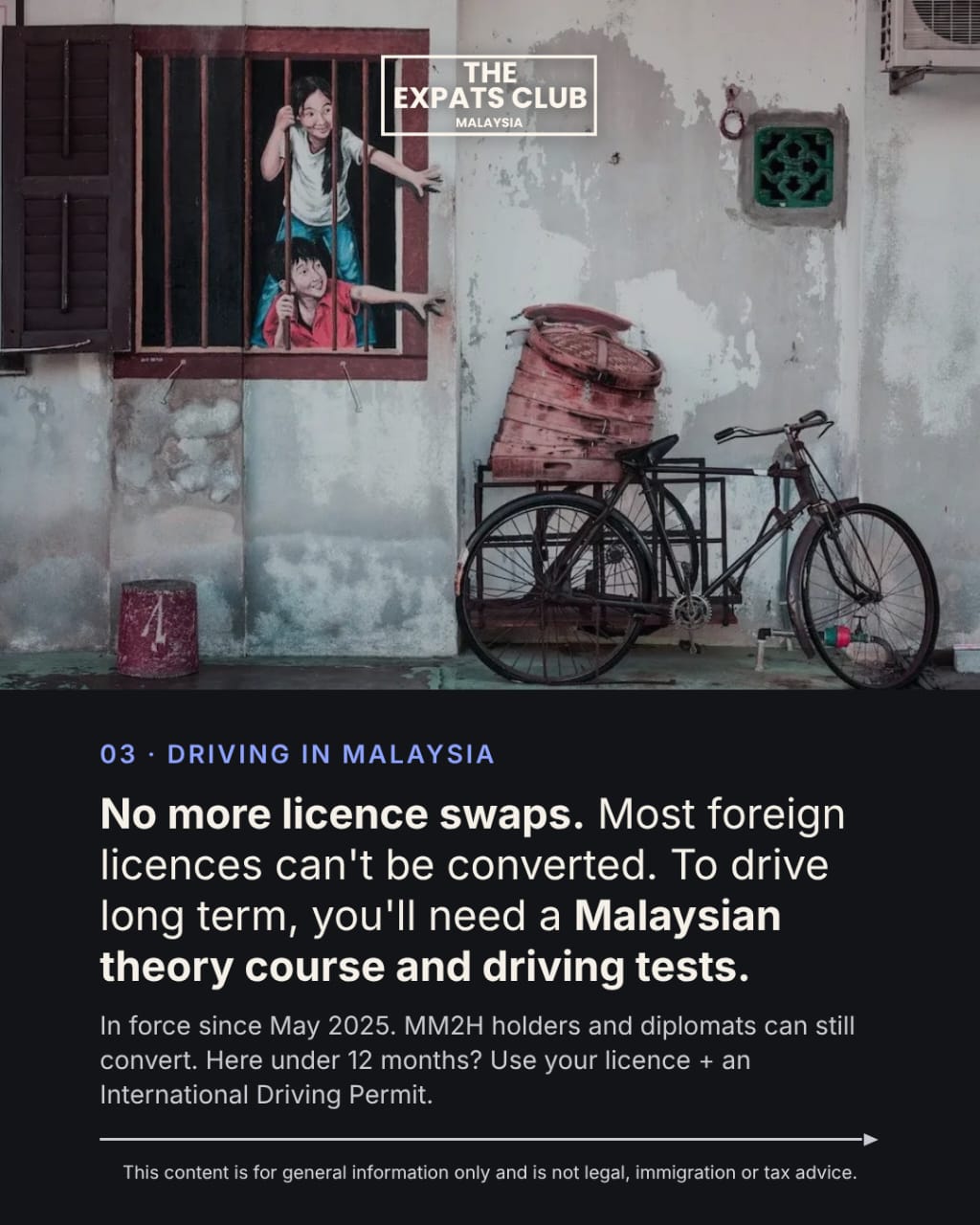
3. You can no longer swap your foreign driving licence
Since 19 May 2025, the Road Transport Department (JPJ) has stopped converting most foreign driving licences into Malaysian ones. This change is from last year, but it still catches out a lot of new arrivals. If you want a Malaysian licence now, you follow the same steps as a local learner:
- Join a driving school and complete the theory course.
- Pass the computer-based theory test (available in English).
- Pass the circuit and on-road driving tests.
Who can still convert: Malaysia My Second Home (MM2H) participants, the diplomatic corps, and Malaysians who only hold a foreign licence.
Staying less than 12 months? You can drive on your home licence with an International Driving Permit, if your country signed the 1949 or 1968 road traffic conventions. ASEAN citizens only need their home licence.
4. Digital nomads can stay up to 4 years
DE Rantau Nomad Pass holders who reach the 2-year limit will be offered 2 more years, for up to 4 years in total. This was also announced in Budget 2027.
Until now, the pass lasted 12 months and could be renewed once. After 2 years, nomads had to switch to another pass, such as an Employment Pass, or leave Malaysia.
Important: you can't apply for the extra 2 years yet. The government hasn't said whether the current income rules will still apply, or how dependants will be treated. If your pass ends soon, keep your remote-work proof, income records and health insurance up to date.

5. Lower income tax for locals and expats
When have you ever known a country to lower taxes? From the 2027 year of assessment, Budget 2027 cuts income tax for many resident taxpayers and raises the basic personal relief for the first time since 2010. It applies to locals and expats alike.
- Basic personal relief: RM12,000 (was RM9,000)
- Chargeable income RM70,001 to RM100,000: 18% (was 19%)
- Chargeable income RM100,001 to RM150,000: 24% (was 25%)
- Income above RM1 million: now taxed at the 30% top rate
The government says about 5 million taxpayers could gain up to RM1,600 more a year.
Does this apply to you? Only if you're a Malaysian tax resident, which usually means spending at least 182 days a year in Malaysia. Non-residents pay a flat rate and don't get personal reliefs.

What it all means for you
Malaysia is being more selective about who it brings in, but working harder to keep the skilled people who stay. Higher salary floors protect local jobs. Working spouses, longer nomad stays and lower tax make it easier to build a long-term life here.
- Working here? Check your Employment Pass category and renewal date now.
- Bringing a partner? Watch for the spouse work rules before January 2027.
- Planning to drive? Budget time and money for driving school.
- Working remotely? Keep your DE Rantau paperwork ready for the extension.
- Earning RM70,000 to RM150,000 a year? You may pay less tax from 2027.

If you're relocating to Malaysia and want advice on anything, just reach out. We're happy to help answer your questions and add you to our community. We've also got free guides at RelocatingToMalaysia.com.
This article is general information only, not legal, immigration or tax advice. Rules can change, so always check with the relevant authority or a qualified adviser. Correct as of October 2026.
Sources
- MOHA to raise expatriate pay floor, cap work duration from June 2026 (Business Today)
- Malaysia overhauls expat policy for 2026 (Malay Mail)
- Budget 2027: Digital nomad pass extended by 2 years (SAYS)
- Two additional years for DE Rantau holders (Emerhub)
- JPJ to stop converting foreign driving licences (FMT)
- Budget 2027: Individual tax relief raised to RM12,000 (Bernama)
- Budget 2027 income tax cuts from YA2027 (Emerhub)


